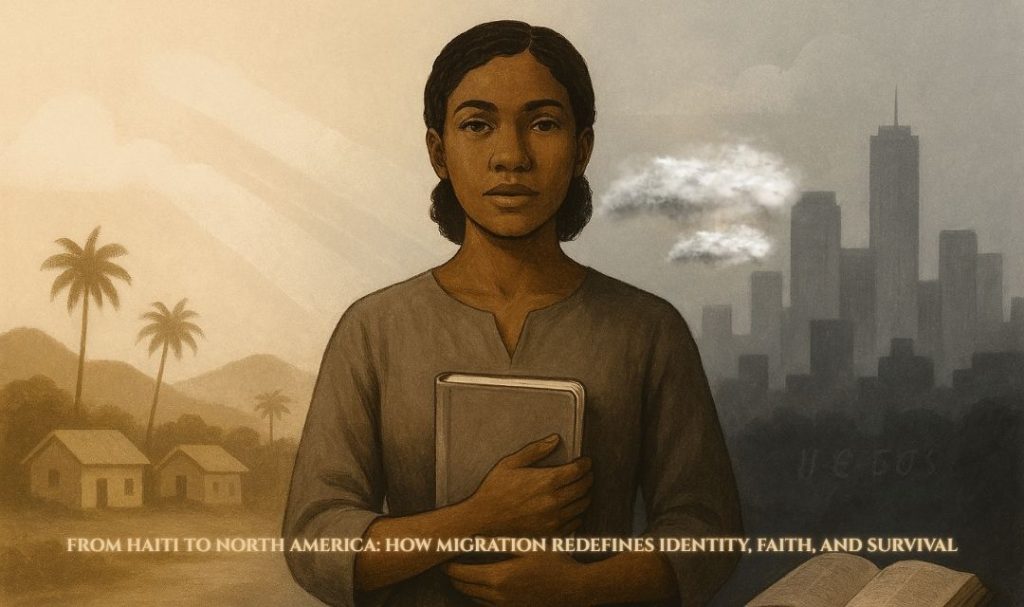
Migration is never a gentle knock at the door. It is a tidal hand, lifting you from one shore and dropping you on another, where even the air tastes different and the mirrors seem to ask new questions. In Enice Toussaint’s memoir, the journey from Haiti to North America becomes more than relocation, it becomes reconstruction. Not the kind built with cement, like her husband’s obsessional contracts, but the kind built inside the self, brick by emotional brick, until identity stands upright again.
The book carries the pulse of Haitian culture; its warmth, its contradictions, its cosmic faith, and its unvarnished truths. Told through journals and family memories, it offers the rare perspective of a Haitian woman who writes not for applause, but for breath. Her voice in the book on Haitian culture feels sincere, candid, and courageous, struck by its emotional honesty and spiritual resolve. Her story stretches across decades of migration, marriage, trauma, resilience, and the long pursuit of personal freedom.
Migration and the Re-making of Identity
Enice’s story begin in Haiti, a homeland she had not returned to for ten years when she followed Jacques in 1996. She describes the country with aching clarity: the architecture familiar, but the atmosphere altered, dirtier, hotter, harsher, foreign even to her own heart. She felt like she was on another planet, unable to adjust to the mentality around her. Jacques, meanwhile, bloomed socially there, claiming nothing in the world could make him return to Montreal. His evenings, however, demanded a “vitamin” only she could supply—sex, violent, entitled, brutal. In the book, identity fractures not in migration, but in the marriages that followed her across borders.
When she finally left Haiti on an American Airlines plane, paid for by selling family furniture and settling Jacques’s debts to protect her dignity, she describes a bittersweet liberation. She missed her family and friends, but not the captivity of a marriage she likened to dictatorship. Migration for Enice becomes an act of self-rescue, reclaiming not only geography, but her name, her autonomy, and her inner voice. Her later choice to exclusively use her maiden name completes the circle of identity reclamation. She acknowledges that actions taken at certain life moments do not always shield us from repercussions, but they shape us nonetheless. The book insists that liberation is not inherited, rather it is earned.
Faith, Trauma, and Survival Strategies
This is a memoir by women who carry their beliefs like lanterns through storms. Enice’s faith is not ornamental; it is functional. She prays before legal hearings, decisions to leave her husband, or when overwhelmed by pain, anxiety, or uncertainty. God is her confidant, her adjudicator, and her refuge when the world refused to listen. When a social worker visited to assess the well-being of her children, she trusted the process entirely because she knew her children wanted the name change. Prayer was her rehearsal before action. Her belief system also reframes the migration narrative itself. While staying with her cousin Gisèle in a collapsing basement sofa apartment, or navigating the Youth Court for adoption and name change, she treats divine intervention not as abstraction, but partnership. She prayed for apartments, judges, angels, courage, and inspiration to continue writing when anxiety silenced her pen.
Travel becomes another survival strategy. Summer vacations to New York and Philadelphia, organized by her, helped her recharge mentally amidst marital despair. She quietly nodded along when friends praised her “perfect marriage,” carrying despair in silence while wearing a public mask of joy. Her suffering was hidden, but her resilience visible only in retrospect. Even trauma is processed through legacy. She writes to her children and grandchildren so they may cherish memory, learn perseverance, and believe that obstacles do not defeat us unless we accept defeat. The book becomes both confession and inheritance.
Writing as the Final Crossing
The structure of her life story is revealed even in dreams. When she envisioned her first book falling off a cliff, she interpreted it as a symbolic closure of her past. Yet, when she returned to an exhibition where her children and grandchildren waited, she realized her work was unfinished. That dream pushed her toward volume three, the final testimony before crossing into a new life phase. The book shows that writing is not merely narration, it is migration’s final paperwork. A signed proof that the past no longer owns you.
Her writing transforms into a long letter-diary addressed to grandchildren, turning memory into dialogue when speech had previously failed. This diary form preserves the multifaceted nature of Haitian culture, migration, and womanhood itself, where laughter and despair coexist, where faith fuels bureaucracy, and where survival requires both spiritual surrender and strategic defiance.

Enice’s memoir reveals that migration reshapes identity, but silence and violence reshape it faster, until a woman decides to write herself back into her own name. It is a testament that Haitian culture lives not in perfection, but perseverance, not in fantasy, but truth, not in the wound, but the voice that finally refuses to whisper.